
Total Solar Eclipse Transforms Europe and Arctic Today; Millions Await Historic Cosmic Event
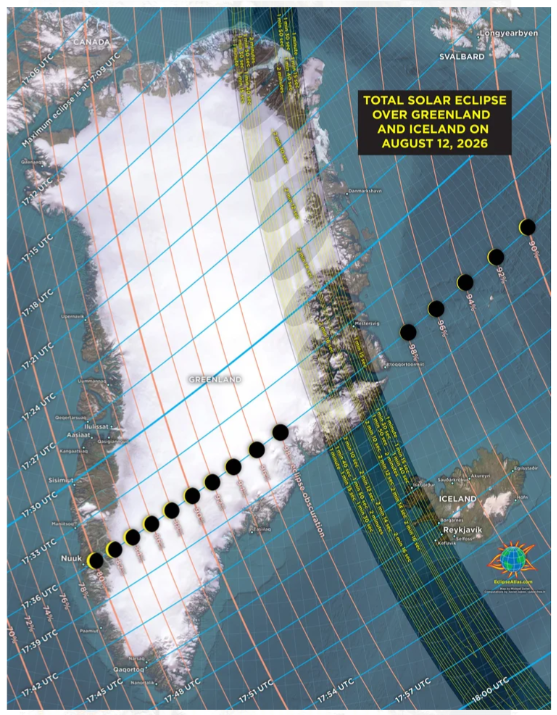
On August 12, 2026, millions of people in Spain, Iceland, Greenland and beyond are witnessing the moon completely block out the sun in a rare total solar eclipse—mainland Europe's first since 1999. The eclipse also coincides with a six-planet alignment and peak of the Perseid meteor shower, making it an extraordinary skywatching day.
A Rare Celestial Alignment
On Wednesday, August 12, 2026, millions of people in Spain, Iceland, Greenland and beyond will see the moon entirely obscure the sun in a spectacular total solar eclipse. Europe will experience its first total solar eclipse since 1999, as the moon's shadow sweeps across Greenland, Iceland, northern Spain and the Balearic Islands.
Historic Viewing Opportunity
On August 12, some 15 million people in Spain, Iceland and parts of Greenland, Russia and Portugal will be inside the path of totality, where the sun is blocked completely, with Wednesday's eclipse marking mainland Europe's first total solar eclipse since 1999. At its longest, near the centerline over the North Atlantic between Greenland and Iceland, the total part of the eclipse will last 2 minutes and 18 seconds.
Wide European Visibility
Most of Europe gets a deep partial eclipse in the evening, with the sun setting while still partly covered in many places, with Paris seeing roughly 92 percent coverage, London 91 percent and Berlin 85 percent. About 980 million people, nearly one in eight worldwide, can see the sun at least partly covered.
A Rare Triple Celestial Event
In less than 24 hours, the sky will put on three major shows — a six-planet alignment before sunrise, a total solar eclipse during the day or evening, and the peak of the Perseid meteor shower after dark. Along the narrow path of totality, day will briefly turn to twilight as the moon completely covers the sun, revealing its elusive outer atmosphere — the corona.
Sources
- https://earthsky.org/astronomy-essentials/total-solar-eclipse-visible-august-12-2026/
- https://www.space.com/news/live/total-solar-eclipse-aug-12-2026-live-updates-1-day-until-totality-what-you-need-to-know
- https://www.aljazeera.com/news/2026/8/10/solar-eclipse-tracker-what-time-will-it-hit-your-location-on-august-12