
OECD Economic Outlook Warns Global Economy Weakens Amid Middle East Energy Shock
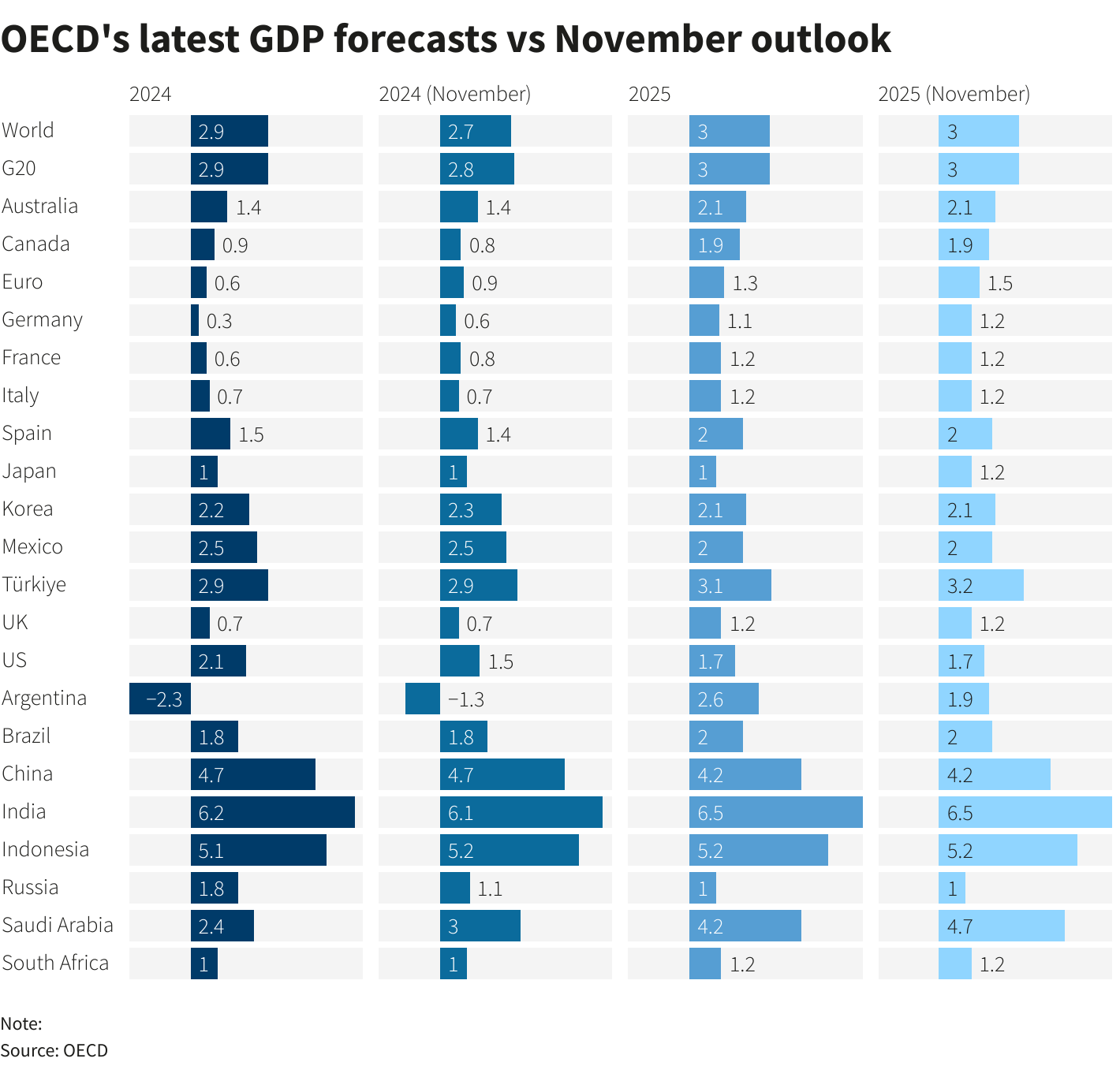
The OECD released its latest economic outlook on June 3, 2026, warning that the evolving Middle East conflict has become the dominant force shaping global economic prospects, driving an energy shock that threatens growth and accelerates inflation across major economies.
The OECD's Bleak Global Assessment
The evolving conflict in the Middle East has become the dominant force shaping global economic prospects, prompting an energy shock that is driving inflationary pressures and is projected to have adverse impacts on growth. On June 3, 2026, OECD Secretary-General Mathias Cormann and Chief Economist Stefano Scarpetta presented the organization's latest Economic Outlook during its Ministerial Council Meeting.
Growth Slowdown in Major Economies
In the time-limited scenario, growth is set to slow modestly in North America and Europe before a tentative recovery, with the United States easing to 2.0% in 2026 and 1.8% in 2027, Canada dipping to 1.2% before rebounding to 1.7%, Mexico strengthening to 1.9% by 2027, the United Kingdom from 0.9% to 1.1%, while China moderates steadily to 4.5% in 2026 and 4.3% in 2027. The organization presented two scenarios—a time-limited disruption and a prolonged scenario extending into 2027—to account for uncertainty surrounding the conflict's duration and economic impact.
Dual-Scenario Approach to Uncertainty
In light of the uncertainty surrounding the conflict's duration and extent, the Economic Outlook provides two scenarios for the global economy. In a time-limited disruption scenario, the sizeable disruptions are assumed to remain relatively short-lived, while in a prolonged disruption scenario, broader disruptions last well into 2027, much longer-lasting negative consequences. The contrast between these two paths underscores how geopolitical instability is reshaping economic forecasts across developed and emerging markets.
Policy Priorities Moving Forward
Chaired by Finland, with Korea and New Zealand serving as Vice-Chairs, this year's meeting focuses on Getting industrial policies right for open markets, growth and prosperity. Policymakers face a balancing act—managing energy price shocks while maintaining support for investment and open trade frameworks during a period of heightened geopolitical uncertainty.